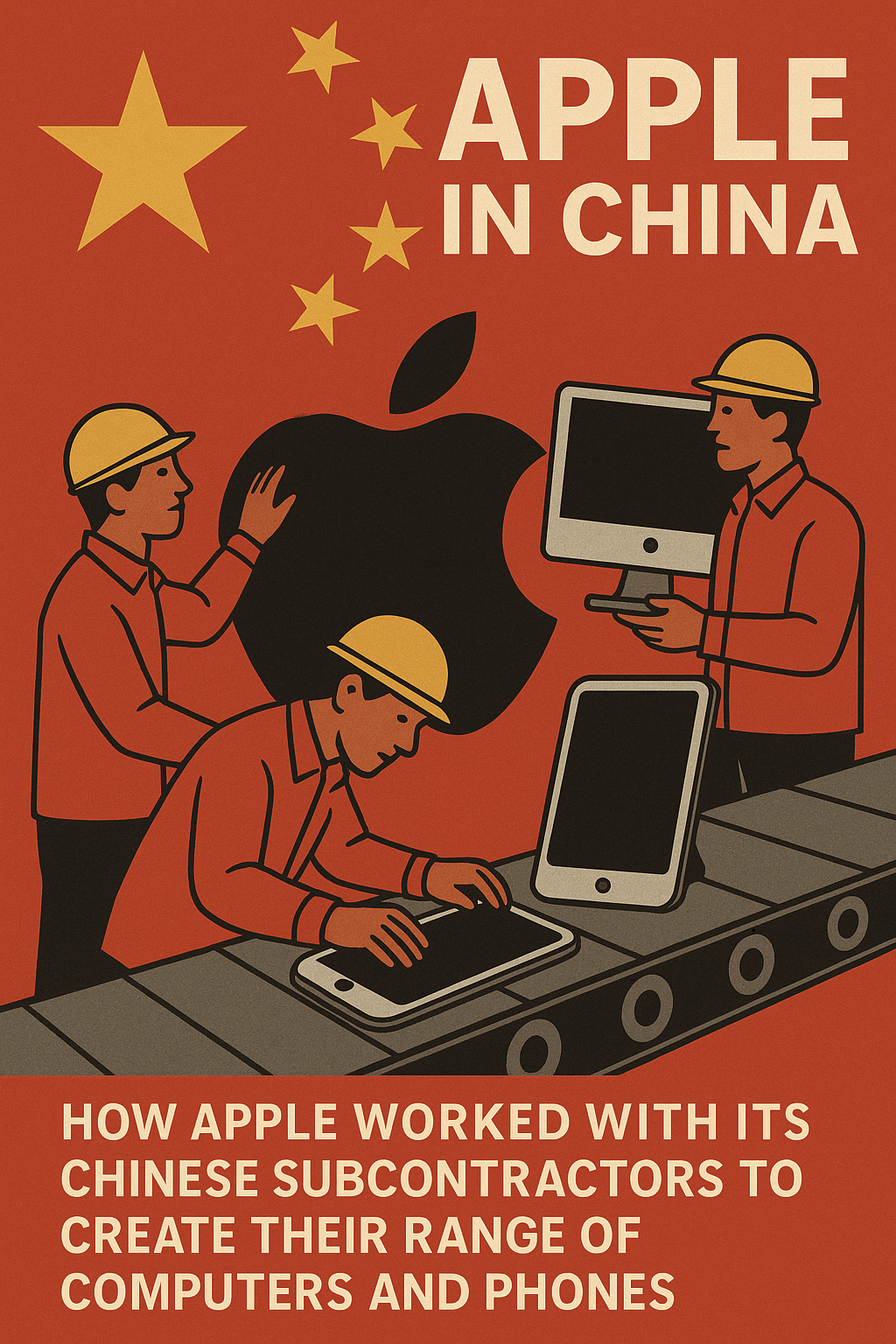
Apple in China

When the Huguenots were forced to flee France, a lot of of them ended up in London. This was a big political event at the time. But when they set up a thriving weaving businesses it had quite a big economic impact as well. No doubt it was the former that was talked about at the time. It is the latter that is better remembered.
It works the other way as well. Development in business have a profound impact on the way history plays out. Both Holland and England have punched way above their weight in international affairs largely on the back of their commercial activities. But the businessmen involved were more concerned about their bottom line than geopolitics.
This is a reality that continues to the present day. One of the most profound events of recent decades has been the rapid, seemingly unstoppable, rise of China from a backwards agricultural economy to a world class superpower able to mount a credible challenge to the worlds current hegemon.
This was probably inevitable. But did it have to work so fast? There is no doubt that a lot of the investment in China from American and European businesses played a part in how quickly China was able to develop. But how big was that part?
Reading this book on the details of Apple’s involvement in China would lead you to believe it might have been quite a lot. It might even have been completely crucial. It’s hard to grasp the scale. The author calculates that adjusted for inflation, the investment into the Chinese economy was of a comparable scale to the Marshall Plan. That is widely regarded as having a big impact on the recovery of European economies after the war. But Europeans didn’t generally need to learn about how to run industrial operations. Apple transferred know-how along with cash.
The Chinese were very aware of how valuable this was. In fact there is a story in the book of how one contractor rotated its engineers so that the maximum number of them would get the benefit of learning from Apple’s engineers. This knowledge diffused out to other companies throughout the supply chain. The government was heavily involved as well. Land was made available for free. Buildings were built. Workers drafted in as they were needed.
There was a lot of non-cheque book actvity from the American side as well. Apple did deals with a US airliner guaranteeing to purchase enough tickets to ensure that flights to airports in China close to their contractors’ faciliities were scheduled. These frequent contacts were the ideal opportunity for the Chinese to learn exactly how to manage the kind of operation and supply chain needed to create new tech. They were contributing to the development of the range from a very early stage.
This knowledge and infrastructure could be used not just for supporting Apple. Competitors and Chinese start-ups could benefit as well. And boy have they ever done so. It’s important not to imagine that the Chinese were just doing the grunt work while the cool Californians were doing the clever and creative stuff. The Chinese learnt quickly and were soon operating at every level in the research and development process. In fact it wasn’t long before Apple were seeking out the partners who offered the best technical support.
I think we will discover that all this was a big factor in China’s newfound ability to create not just new mobile phones, not just new computer Products but also things like high-tech missiles and aircraft. A lot of the cat that the Chinese military are equipping themselves with now are equal to or even better than the American equivalent. The only thing they lag behind significantly in is direct combat experience. Let’s hope that gap stays wide.
But the reality is that western firms, for reasons that were pretty much entirely commercial and short term, have significantly hastened the emergence of China as a global power. It cannot be undone. We will have to live with the consequences.