A Man For All Seasons

A Man For All Seasons
“This country is planted with laws from coast to coast…Man’s laws, not God’s, and if you cut them down…and you’re just the man to do it…do you really think you could stand upright in the wind that would blow then?
Yes. I give the Devil benefit of law for my own safety’s sake.”
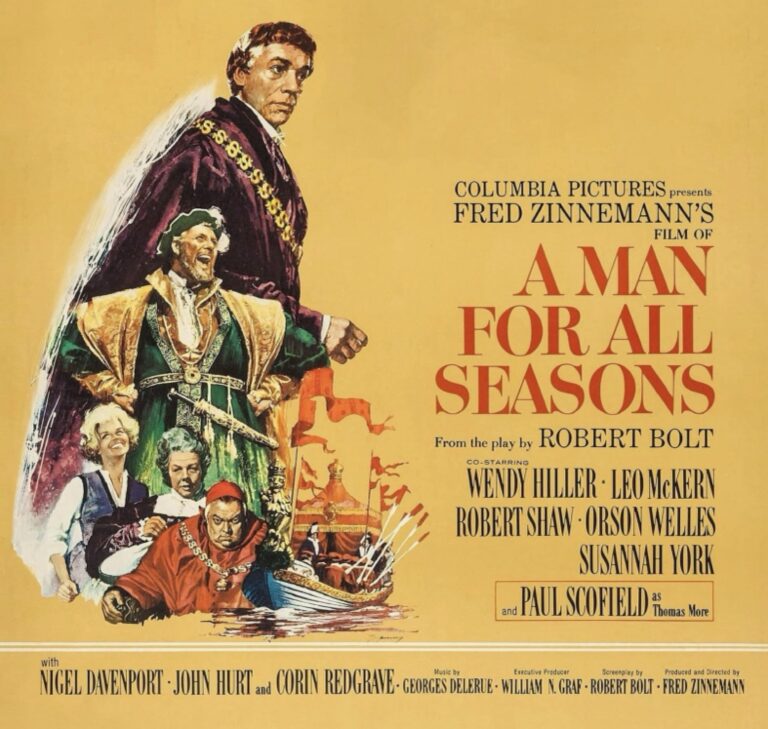
Autumn is just beginning here in the UK, and a colleague has given us a large quantity of rhubarb. We need to freeze it. In the process we referred to an old book we’ve had for decades that is titled A Freezer For All Seasons. I assumed that this was a reference to the film with a similar name. This was released in 1966 Google informs me. I have seen it on telly at some point though I remember little about it. But I do remember it was much talked about.
It’s the story of Thomas More. He didn’t need to be introduced back when the film came out. The details of Henry VIII’s domestic problems and how they led to the break with Rome were at the time well known and seemed important to the state of Britain. We were a Protestant country. In some ways, we were the Protestant country. This was the work of Henry and his daughter Elizabeth – and was clearly a ‘good thing’. We had a religion founded not by divine revelation but by act of Parliament and this made us special in some undefined way. More was nonetheless an admirable character despite his opposition to the project. So he was an obvious and natural subject for a film.
Today it seems highly anachronistic. For a start, I don’t imagine many people under the age of 50 in the U.K. would have any idea who More was. For those of us who do, it isn’t at all obvious why we should care. The Church of England is nowadays largely a curator of some old and rather beautiful buildings. It no longer figures as a power in the land.
So I have a feeling that this film would not have instant appeal to current audiences. We no longer care about the big issues it covers. But it is still an interesting investigation of the interplay between what feels right and what is expedient. Thomas More chooses to do what his conscience tells him to. He is extremely aware of the consequences. And he suffers them. But this is a real life story full of real life people. Those close to the hero are in great danger of suffering as a result of his determination to stick to the path he regards as right. You can’t help but wonder what you would do in the same situation. The film portrays more as a heroic figure, but with a bit of ego and hypocrisy to go with it. I don’t know a huge amount about the real man, but I suspect he probably wasn’t quite as noble as he’s betrayed here. But it works pretty well as drama.
The film works pretty well as a film too. It tells its story well. You don’t need to know the background to follow the plot. But if you do it does a good job building up to the climax you know is coming. The only very slight glitch is that some of the text is authentic and comes directly from sources of the time. You can tell the difference between the modern dialogue and the Tudor stuff. The filming is really good and helps create the atmosphere and even tell the story. But I have a feeling that England in the reign of Henry the eighth wasn’t quite as clean and tidy as it is portrayed.
I’m not a fan of the Catholic Church and I don’t think that defending it was a good moral choice even in More’s time. But that doesn’t really come up. The question is sticking with your beliefs despite the pressure from authority and day to day practicality. More’s friends, family and servants are as exasperated with him as Henry VIII is. And of course they are affected by his actions as well. This film doesn’t work as propaganda for a cause.
The two hours of running time would’ve been quite standard in the 60s. And it’s just the right length for what it is trying to do – it does work best if you watch the whole thing from end to end. That’s quite an ask in our world filled with things to grab our attention. It seems a minor matter. But I think it will mean that very few people choose to watch it. It’s a pity because it’s an interesting and thought provoking film that simply couldn’t be made today.