A Socialist reads the Hobbit Part 15 – The Journey Home

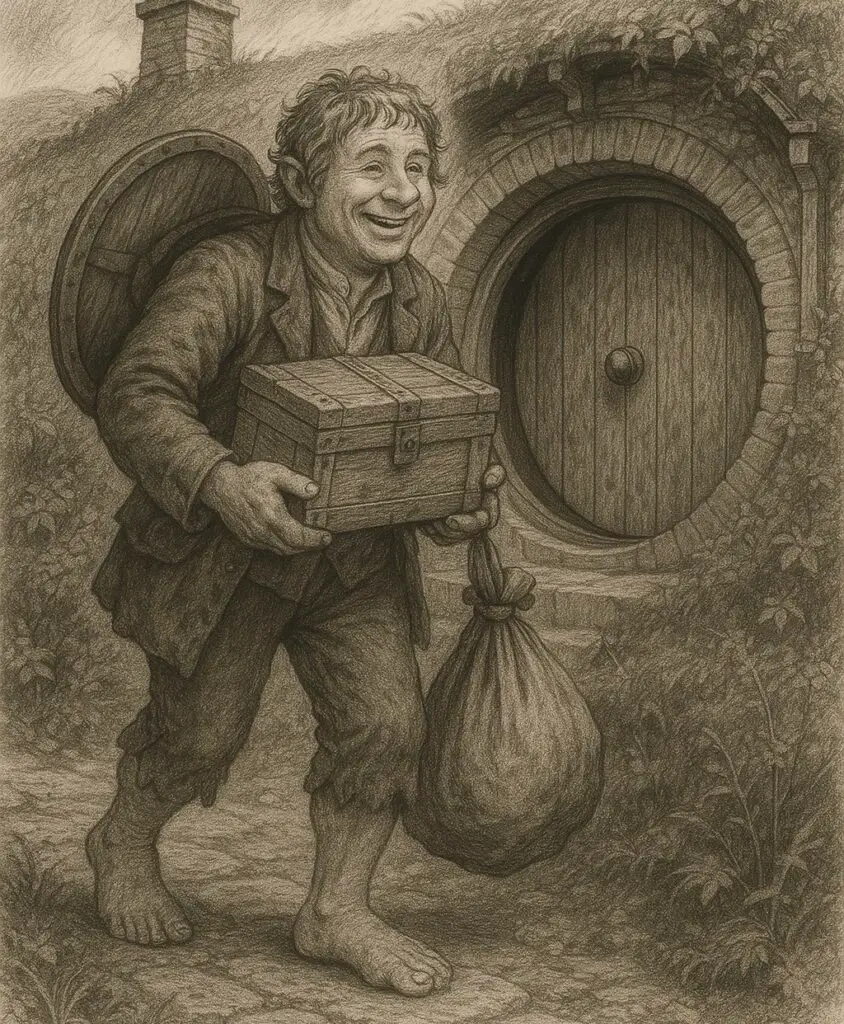
The book winds up pretty quickly after the battle. Bilbo returns without any further adventures on the journey. Tolkien fans are often frustrated by the numerous works that the great man started but never finished. But the trouble is that finishing a book is no trivial matter for Tolkien. The Hobbit is a case in point with Bilbo retracing his steps through all the places he visited on the way out. No thread is allowed to remain untied up and most scenes get a least something of a revisit. Bilbo and Gandalf even remember to dig up some gold that they had buried after their encounter with the trolls, even though it seems somewhat superfluous now that they already have as much precious metal as they can carry.
There is one last surprise waiting for him. He gets home to find that he has been presumed dead and his estate is being sold off. Luckily he lives in a region – it is not yet known as the Shire – where property rights are respected. Bilbo knows the system and manages to reclaim his hole without too much difficulty. He has come back with a large amount of disposable cash and can now live a life of leisure. But he is a changed hobbit and is now a lot more bohemian and open minded than the conformist he had started out as. He now has multicultural contacts and literary pretensions. In the next book, the Lord of the Rings, we see Bilbo becoming a nucleus of progressive thought, but that is another story.
So now we have finished it, what do I make of the Hobbit.
I think whatever else it is, it’s a great story. I still remember on first reading being really eager to read on and find the next adventure. I have mentioned before that it’s structure is that of a picaresque novel with the journey providing the link to a series of scenes. It is a format that works well and it is clear that Tolkien – like nearly every reader of his generation – was very familiar with the work of the likes of Dickens and Smollett. These are people we now regard as serious literary masters but it isn’t that long ago that they were simply popular writers, and it was their ability to come up with great stories that made them so. The ability to tell a good tale is a rare skill and Tolkien’s ability to do so is the key to the enduring popularity of the Hobbit.
The influence of other Victorian writers can be detected as well. Bilbo would fit right into a Trollope novel, as indeed would many of the other characters. Thorin reminds me a lot of Archdeacon Grantly from the Warden. Another touch of Trollope is the way that Tolkien from time to time breaks down the fourth wall. Authors addressing the reader directly is not something that everyone approves of, and in Tolkien’s case it might be a residue from the Hobbit’s origin as a book he read to his children. Reading it as an adult you do notice how condescending this comes across. Tolkien himself later regarded the slightly patronising tone of the Hobbit as a flaw, and I think he was right in this. But it is one I don’t remember troubling me when I read it as a child.
The bigger influence on the Hobbit is of course fairy stories in general. I regard the Grimm brother’s stories as virtually unreadable but it is clear that Tolkien has read them and carried over some of their features. For a start the world of the Hobbit is a very savage one. Thorin ends up dead. Bilbo only escapes the battle by luck. Don’t think of fairy stories in terms of Walt Disney’s Snow White – which funnily enough appeared on screen the same year as the Hobbit was published – think of the Grimms’ ending of the story where the wicked queen is forced to dance herself to death.
Another influence that comes to the fore at the end of the book is Anglo Saxon literature, of which Tolkien was of course a professor. Thorin’s charge at the Battle of the Five Armies could have come straight out of any number of Norse or Icelandic sagas. The one that springs to my mind is the Battle of Maldon, an Anglo Saxon poem recounting an heroic and unsuccessful stand of the Saxons against the invading Vikings in what is now Essex. The description of the action is rather reminiscent of this, and the sudden appearance of some rather heroic language reinforces it. We are still in a fairy story, but we have some passages that would fit into something rather weightier. It is a measure of Tolkien’s skill with language that he can switch register like this without it being jarring for the reader. While this is going on we still have Bilbo showing nothing but contempt for violence, and simply wishing none of it was happening.
But finally, what of my thesis that the Hobbit can be read as a metaphor for socialism despite the fact that this was not a philosophy that Tolkien himself subscribed to. I have to confess that there have been moments where I have struggled to reconcile what is in the book with how I would like to read it. It would have been an easier job to have gone through it looking for concordances with Christianity in general and Catholicism in particular. But had that been my goal, I would still have had problems. Unlike Narnia, Middle Earth is recognisably a version of Earth. It is one that presumably predates Christ himself, which at least gives you an excuse for why God is not quite as in your face as you would expect. He is there if you look for him. But even so, He is behaving in a distinctly hands off fashion. He is mainly operating through the large number of astonishing coincidences of the plot, all of which in one way or another lead to both a generally desirable happy ending and to the personal growth of Bilbo himself. But most books are like this. The most realistic novel is set in an imaginary universe just as much as a fantasy story is. And there is always an invisible presence pulling the strings in the background in the form of the author. Many an author contrives to take his characters on a journey via his plot. It is the same process that Christians believe the Almighty is using to take us on a journey via his creation. But that doesn’t mean that the former is necessarily inspired by the latter.
Where the Hobbit does correspond with Christianity is that there is a distinct sense of right and wrong. There are many instances of characters acting simply to do the right thing in the Hobbit. The best example is that Bilbo gives the Elven king an emerald necklace as a retrospective payment for the food and drink he had burgled from him during his stay. Socialism has a very similar set of values to Christianity – indeed the overlap is a lot closer than either side would probably choose to admit. So it was not too difficult for me to hijack the moral code Tolkien had in mind and apply it to the one I personally prefer. At the end of the day, both political and religious ideas are constructs. They both derive from our innate sense of justice and fair play. And both are inevitably to some extent distorted in the process. That is where all the arguments come from.
Thorin and Bilbo fall out over a knotty political problem. Bilbo’s peacenik activities led to a breakdown in their personal friendship. But luckily, solidarity was restored before the end. On his deathbed he repents of his warmongering and, because the two things are ultimately linked, his desire for excessive wealth. His last words to Bilbo before he dies of his wounds are –
“If more of us valued food and cheer and song above hoarded gold, it would be a merrier world. But, sad or merry, I must leave it now. Farewell.”
You will be looking for a long time before you find as succinct and well put a summary of socialist values as that.
I hope you have enjoyed this series, whether you are a hobbit-head, a christian, a socialist comrade or indeed even if you are capitalist, a fascist or a bourgeoise counter-revolutionary deviationist. The Hobbit is a book with a wide appeal and my own very particular reading of it is just one of many. It is a book that is both very much of its time, and one that is likely to enjoyed long into the future. It was first reviewed by C.S.Lewis, who predicted that it would become a classic. He may well be right, indeed he is probably already right. If so, readers in the future will probably not be able to read it in the naïve and uninformed way I was able to. Classic books soon attract a set of tropes and preconceptions that make it impossible to read them without having your impressions to some extent modified. There is already an extensive literature on the Hobbit and Tolkien’s other work. I haven’t read much of it, so my impressions are, for what they are worth, very much my own. I hope they were of some interest, and thanks for reading.